



Beyond the Saddle
Working Roles for Horses Outside of Riding & Recreation

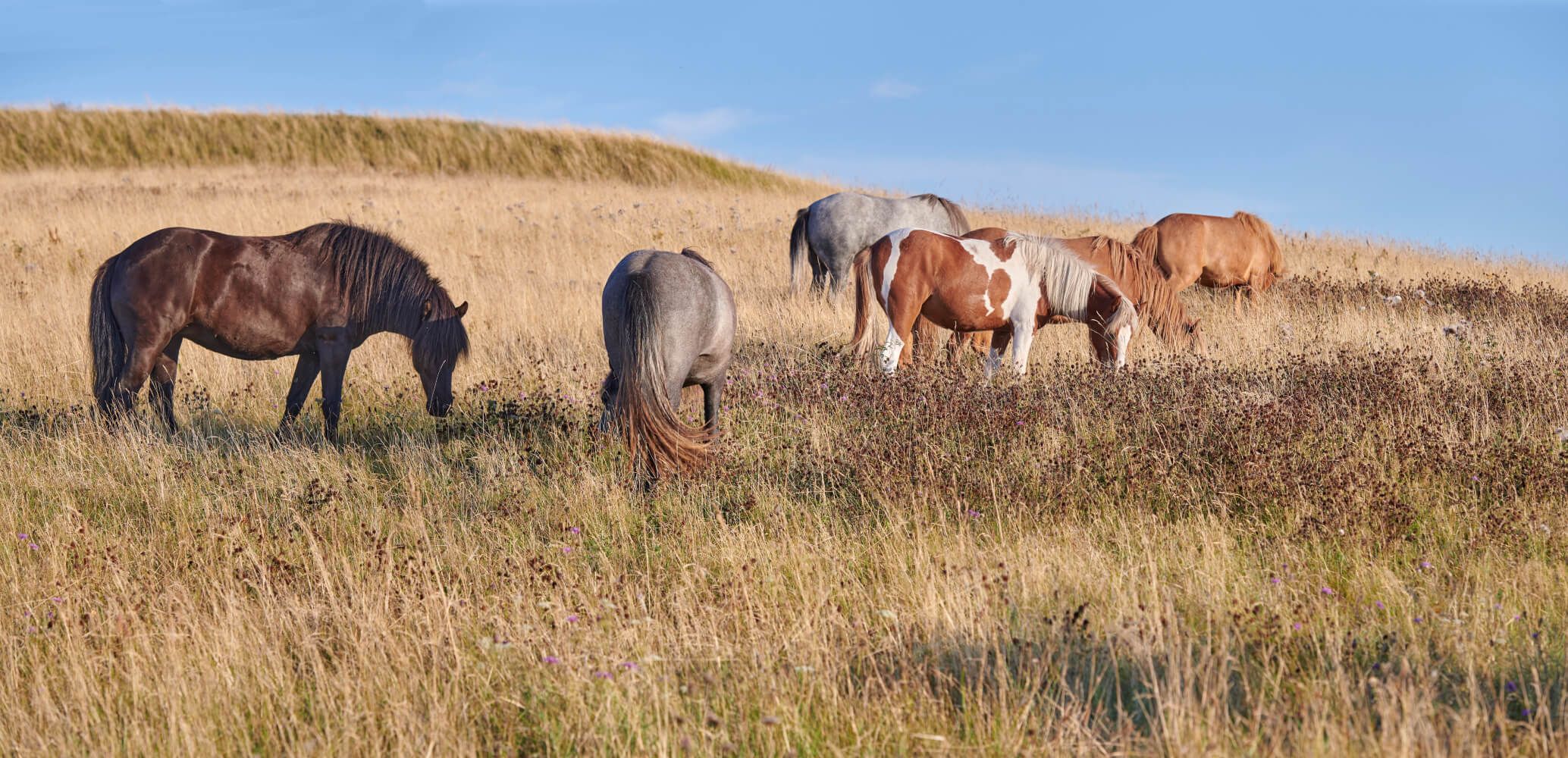
Sometimes, there’s no better view than a horse grazing off in a field, or no better feeling than traveling horseback through the mountains.
Our horses today provide us with countless recreational opportunities, fantastic riding partners and devoted companionship, but for centuries, these powerful animals have been essential to transportation, farming, heavy hauling and countless daily tasks.
While most traditional equine roles have been replaced with modern machinery, horses still serve practical purposes on farms, ranches and homesteads. They are more than just our companions; they are versatile working animals that fill many roles, ranging from livestock management to ecological stewardship.
Hauling
Traditionally, draft horses have held many hauling, pulling and transport roles on the farm. These range from carting wagons and materials to delivering merchandise, transporting people and performing heavy farm work. Most of these roles have now been replaced by machinery, from plows and trucks to the modern tractor.
According to the American Farm Bureau Foundation for Agriculture, horses can offer a sustainable and cost-effective alternative to modern machinery, especially in winter when a machine could fail to start. They are great at hauling wagons of feed for livestock, or even a plow, as exemplified by Michigan State University.
The university notes that its Draft Horse Program was among the finest of its time, particularly from 1910 to 1930, when it earned 155 championships and 211 first-place finishes. Although the program was discontinued in 1963, the horses returned 36 years later, including for the 2002 MSU Plow Day, the first time in more than 40 years that horses had plowed university grounds, and again in 2004. MSU has expressed hope that the Draft Horse Program will continue into the future.
While this job for draft horses is becoming less and less common by the day, they still fill many essential, everyday roles. Patricia Crane, a horse enthusiast and sculptor, notes that they are mighty in show rings, hitches, multiple hitches, parades and pulling and plowing contests. It’s not uncommon to find a team pulling a float at a local parade.
While there are more than 40 distinct draft horse breeds that are recognized globally, some of these gentle giants include the American Cream, Ardennais, Auxois, Belgian, Boulonnais, Brabant, Breton, Clydesdale, Comtois, Norman Cob, Percheron, Renish German, Schwarzwalder Fuchs, Shire and Suffolk Punch.
Equipment
Another, less common, even rare, role for horses is horse-powered equipment. Beyond just plows, rakes, mowers and planters, some machinery runs on equine power. Feed cutters, silo blowers and small grain elevators can be powered by horse treadmills, inclined platforms with belts.
There are also horse mills, or horse sweeps, where the horses walk in a circle to rotate a central gear that powers threshing machines, corn shellers, wood saws and grist mills. The Kenneth and Katie Copp family, part of the Unity, Maine Amish community, runs a horse-powered mill to produce flour. The draft horses are hitched to the drum and begin moving on voice command.
According to an article by Amish America, the horses walk at an average speed of three revolutions per minute, and when converted to the “horse-power” through the drum, the shaft operates at 300 revolutions per minute. This power combined with a system of continuously running belts allows the family to run several standard woodworking power tools as well as the grain grinder.
While this is not common today, even in most Amish communities, it is still a display of the versatility that our horses can provide on our own homesteads.
Livestock
The classic image of a working horse includes more than just the traditional draft horse, however. Many people might picture a ranch or cow horse, herding and roping cattle in the field. Out West, especially, this image still holds.
Ranch horses, also known as cow horses, are used for working and herding livestock. These breeds include the American Quarter Horse, Camargue pony, American Paint Horse and occasionally the Appaloosa.
Most recognize these working horses from rodeos and other horse shows, but their value goes far beyond the arena. On farms and ranches, they play a key role in day-to-day cattle management, handling everything from reining and fence work, where a rider works a cow one-on-one, to larger herd work out in the pasture. They’re also used in team penning and roping events, including team roping, calf roping, breakaway roping, steer stopping, goat tying and single steer roping.
The use of all-terrain vehicles (ATVs) does pose some risk to the stability of horses in this line of work, but many producers find that horses offer multiple advantages that outweigh the use of ATVs. Primarily, they can take the stress off livestock, as horses create a natural environment that the cattle are used to. Lazy T Ranch out of Ten Sleep, Wyoming, notes that calmer cattle are easier to maneuver, and stress can actually influence the tenderness and flavor of the beef as well as damage cattle’s organs and affect how they process waste.
Horses can move livestock at a slower pace, reduce the chance of injury and support the overall health of cattle. They also leave a smaller environmental impact, whereas ATVs compact soil, damage local foliage and pollute surrounding environments with gasoline, oil leaks and other emissions. Lazy T Ranch states that horses are fantastic for navigation, as they are perceptive, mobile and may be able to find the cattle before the rider.
On top of all of the other advantages horses provide for livestock herding and movement, this role also helps uphold the culture of “The West.” Ranches have been moving their animals with horses for hundreds of years, across hundreds of miles and terrain. Not only is it effective, but it also starts to become a way of life, identity and legacy.
Ecology
In some cases, horses can also be used for targeting grazing and vegetation management efforts. The University of Minnesota describes targeted grazing as the careful use of livestock to meet vegetation management goals, significantly reducing the amount of undesired plants in an area.
This method tends to increase the amount of plant species and diversity in grazed areas, generally thought of from an ecological perspective as a positive response. However, the study from the university noted that there are gaps in knowledge about how effective targeted grazing can be, such as the long-term outcomes and native plant species restoration.
The study describes that employing livestock for invasive plant control can seem appealing, but there is not a strong enough scientific foundation to determine if it's the right approach.
Therapy
For those already sharing a deep connection and understanding of their horses, it will come as little surprise that the use of these animals in several forms of physical and mental therapy has proved effective.
A paper from the Northern Clinics of Istanbul found that horses are successful with hippotherapy, a physical, occupational and speech therapy that uses the characteristic movements of a horse to provide motor and sensory input. The horse is able to provide rhythmic movement to stimulate anterior and posterior swinging movements, allowing riders to achieve proper balance and posture while offering them a large range of sensory inputs.
A study published by the Journal of Clinical Medicine also found that equine-assisted therapy (EAT) can provide several benefits to those with neruomotor, developmental and physical disabilities, including the elderly and children with cerebral palsy (CP). EAT can improve posture, balance, mobility, function and sensory abilities through the motion of the rider’s body. The study found that children with CP had improvements in walking, running and jumping and elderly individuals saw improved mobility.
There are also some programs that found that equine communication is valuable in trauma therapy as well. For those with post-traumatic stress disorder (PTSD), anxiety and depression, this type of therapy relies on the horses natural response to human emotions. Purdue University states that the animal’s ability to reflect human emotion without judgement can help clients develop trust, gain insight and achieve breakthroughs in healing journeys.
One Animal, Many Roles
Beyond hauling, livestock work, ecological services and therapy, horses remain among the most versatile animals on the homestead. They can carry pack supplies, accompany trail rides and camping trips, help check fence lines and provide transportation across large properties. In some areas, horses are also considered a deterrent to predators, though evidence of their effectiveness is limited. As prey animals, their natural instinct is to flee, and they can be especially vulnerable during foaling.
Still, horses have proven their value in countless other ways. Throughout history, they have worked alongside people, helping with everything from daily chores to long-distance travel. While riding remains one of their most familiar roles today, horses continue to serve a variety of practical purposes on farms, ranches and homesteads. More than simply a recreational animal or a working tool, they have long been trusted partners whose versatility and companionship have endured for generations.
Tags:Horse Sense












Acreage Life is part of the Catalyst Communications Network publication family.