



Rainwater Harvesting 101
What Falls From the Sky is Worth Keeping

For small-acreage owners, water is rarely far from mind. Whether you're hand-watering a kitchen garden, managing livestock through a dry August or trying to reduce your dependence on a well that's been running harder than you'd like, the question of water availability tends to come up season after season.
Rainwater harvesting, the practice of collecting and storing precipitation for later use, is one of the older solutions to that problem, and it's seeing renewed interest for good reason.
The approach scales in almost any direction. A single rain barrel under a downspout can meaningfully offset irrigation needs for a modest garden. A properly engineered cistern system can supply tens of thousands of gallons for broader property use. The gap between those two options is wide, but it doesn't have to be crossed all at once. Many small-acreage owners start simple and expand as they learn their land's patterns and their own water needs.
Before getting into the how, a practical note: rainwater harvesting is regulated differently depending on where you are. According to Pacific Northwest National Laboratory research compiled for the U.S. Department of Energy, state regulations vary widely.
Some states actively encourage it with tax incentives; others have historically restricted it, though most of those restrictions have loosened in recent years. Extension resources in your state are the most reliable starting point for understanding local rules, and should be consulted before investing in infrastructure.
The Basics of Roof Collection
Most small-scale rainwater systems begin at the roof. Rooftop collection is efficient because it concentrates rainfall from a large surface area and channels it through existing gutters and downspouts, which is infrastructure that many properties already have in place.
The basic math of collection is straightforward, and worth knowing before you start sizing storage:
- The rule of thumb: 1 inch of rain on 1,000 square feet of roof = roughly 600 gallons collected (according to the University of Arizona Cooperative Extension)
- Real-world efficiency: Plan for 80 to 85% of theoretical yield, accounting for evaporation, first-flush diversion and overflow (according to the Texas Water Development Board (TWDB))
- Example: A 2,000-square-foot roof in a region with 30 inches of annual rainfall can realistically yield more than 30,000 gallons per year
How that rainfall is distributed across months matters as much as the annual total.
Roof material affects water quality, which in turn affects how collected water can be used. Research commissioned by the TWDB and conducted at the University of Texas at Austin found that metal roofs, particularly unpainted galvanized or standing-seam steel, are generally considered the cleanest option. Asphalt shingles are more common and still workable for non-potable uses, but the same study noted that shingle roofs can introduce more particulates and some chemical concern. Treated wood shakes and roofs with lead flashing are typically avoided for collection systems.
Whatever the surface, most practitioners and extension guides recommend a first-flush diverter: a simple device that captures and discards the initial runoff from any rain event. The University of Hawaii Cooperative Extension notes that the initial runoff from any rain event carries dust, debris and fecal matter that has collected on the roof and in gutters since the last rainfall.
Rain Barrels
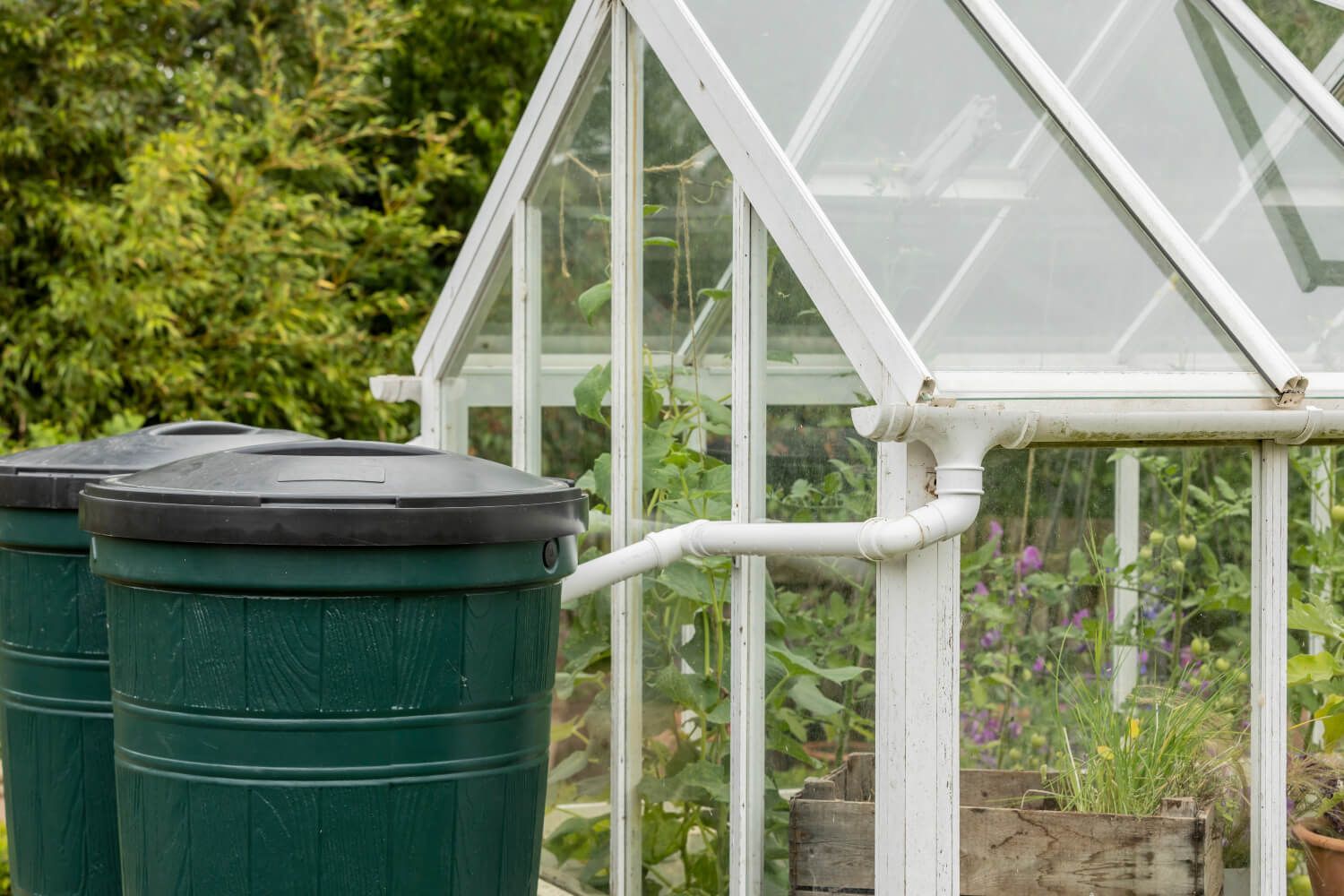
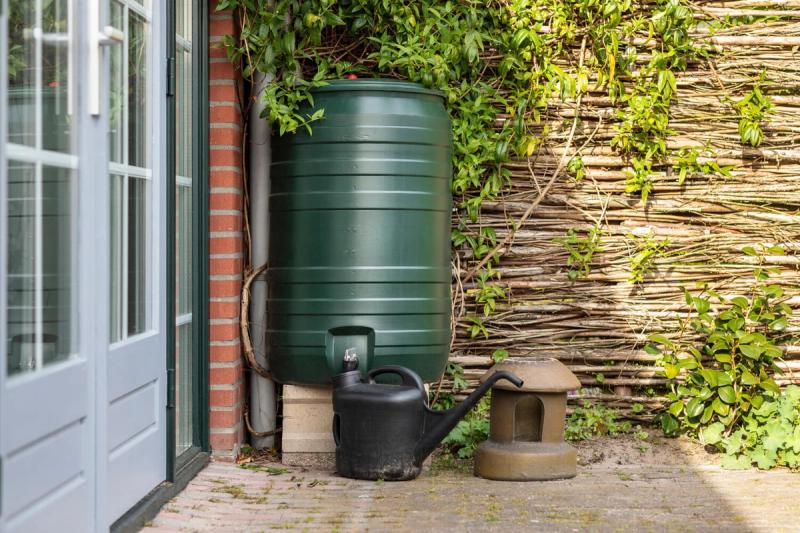
For property owners new to rainwater harvesting, a rain barrel is the most accessible entry point.
Standard commercially available barrels hold between 50 and 100 gallons and connect to a downspout via a simple diverter kit. Setup typically takes an afternoon. Cost runs from around $50 to $150 for a basic unit, though repurposed food-grade barrels can bring that down considerably.
The practical ceiling of a single barrel is also its limitation. A 50-gallon barrel fills quickly during even a modest rain event and, once full, simply overflows. For a container garden or a few potted plants, that may be sufficient. For anyone irrigating a meaningful garden plot, 50 gallons disappears fast; it's roughly the equivalent of running a standard hose for three or four minutes.
Linking multiple barrels in series is a common and cost-effective way to increase capacity without moving to a more complex system. With a few barrels daisy-chained along a downspout run, property owners can accumulate several hundred gallons of storage without significant infrastructure investment. This approach works well for seasonal garden irrigation and can serve as a useful learning phase before committing to something larger.
Intermediate Tank Systems
When storage needs outgrow what linked barrels can provide, purpose-built polyethylene tanks are the next logical step.
These range from 250-gallon units that can still be managed by one or two people to 1,500- or 2,500-gallon tanks that require placement planning and, in some cases, a small foundation or gravel bed for stability.
Intermediate tank systems benefit from a few components that barrel setups often skip. A proper first-flush diverter becomes more important at this scale. A floating intake filter helps draw water from mid-tank rather than the sediment-laden bottom. A vented and screened overflow outlet prevents mosquito breeding and manages excess during heavy rain events. The CDC notes that adult female mosquitoes can lay eggs in even small amounts of standing water, making covered and screened storage a basic precaution. These aren't especially expensive additions, but they meaningfully improve water quality and system longevity.
Placement matters here in ways it doesn't with a barrel. Tanks need to sit close enough to the roof catchment to connect without complex plumbing, but positioning them slightly elevated on a platform or a gentle slope allows gravity to do the work of moving water to where it's needed. Even a foot or two of elevation can provide useful pressure for drip irrigation without the need for a pump.
At this scale, it becomes practical to connect storage directly to an irrigation system. Drip tape and soaker hose setups work well with the low-pressure output of a gravity-fed tank. For anything requiring more pressure, such as overhead sprinklers, for instance, a small submersible or booster pump is typically needed.
Cisterns and Integrated Systems
For property owners with significant water needs or limited well access, buried or above-ground cisterns represent a more substantial investment that can also deliver more substantial returns.
Cistern systems commonly range from 2,500 to 10,000 gallons or more. Installed underground, they preserve surface space and maintain more consistent water temperature, which can reduce algae growth and extend water quality.
At this scale, system design becomes more involved. Inlet filtration, overflow management, extraction pump sizing and water treatment all need to be thought through together. Some property owners integrate cisterns with pressure tanks to supply livestock waterers or outbuildings. Others use them as backup storage for irrigation during dry spells, drawing first from the cistern before tapping a well or municipal line.
Cost for a fully installed underground cistern system can range widely, from a few thousand dollars for a DIY polyethylene tank installation to $10,000 or more for a poured-concrete cistern with full filtration and pump infrastructure. Extension offices and state water resources agencies sometimes have cost-share programs or rebate incentives that can offset part of that investment.
Water quality at this level also warrants more careful attention.
The TWDB notes that collected rainwater, as it falls through the atmosphere and across a catchment surface, may pick up microbial and chemical contaminants that must be addressed before the water is used indoors or for drinking.
For irrigation of food crops, a basic sediment filter and annual testing are generally recommended. Rainwater is not typically treated for drinking without a comprehensive and certified treatment system, and the TWDB is explicit that even after treatment, local health department guidance should be consulted before any potable use.
Matching System to Property
The right rainwater harvesting setup depends on a combination of factors specific to each property: average annual rainfall and its seasonal distribution, roof area and material, intended use of collected water and existing infrastructure. Extension resources from land-grant universities in most states offer region-specific calculators and planning guides that can help work through those variables.
A useful starting exercise is to map your water use by season alongside your rainfall pattern. In many parts of the country, the months when irrigation demand peaks are the same months when rainfall is lowest, which means storage capacity is what bridges the gap, not collection rate. Understanding that relationship early helps with sizing decisions and prevents the common disappointment of a well-designed system that still runs dry in July.
For property owners at the beginning of that planning process, starting with a barrel or two at a frequently used downspout is a low-risk way to build intuition. How fast does it fill? How quickly do you draw it down? How does water quality look after a few weeks of storage? Those observations tend to be worth more than any calculator when it comes to deciding on the next step.
The practice of catching rain and putting it to work is about as old as agriculture itself. The particulars — tank materials, diverter fittings, drip tape — are modern, but the underlying logic is unchanged: water that falls on your land is a resource, and capturing even a fraction of it builds a kind of resilience that is hard to put a dollar figure on.
Tags:Homestead How-To
















Acreage Life is part of the Catalyst Communications Network publication family.